

This logo was used as the medical equipment side of the business expanded, I have not found a logo from the early years of the company.
José Lifante Hurtado was born in Barcelona in 1925. He had no formal education and worked as a sailor, until he was struck down by polio. He developed myelitis and, by the time that he turned twenty-one, it left his legs permanently paralysed.
To earn a living, he trained in accountancy and joined a car repair workshop as their bookkeeper. He worked in a small office and got round by using a hand propelled wheelchair. José Lifante had seen someone using a French made motorised wheelchair and, eventually, he managed to save enough money to buy one. Unfortunately, he couldn’t find one in Barcelona and had to import one.
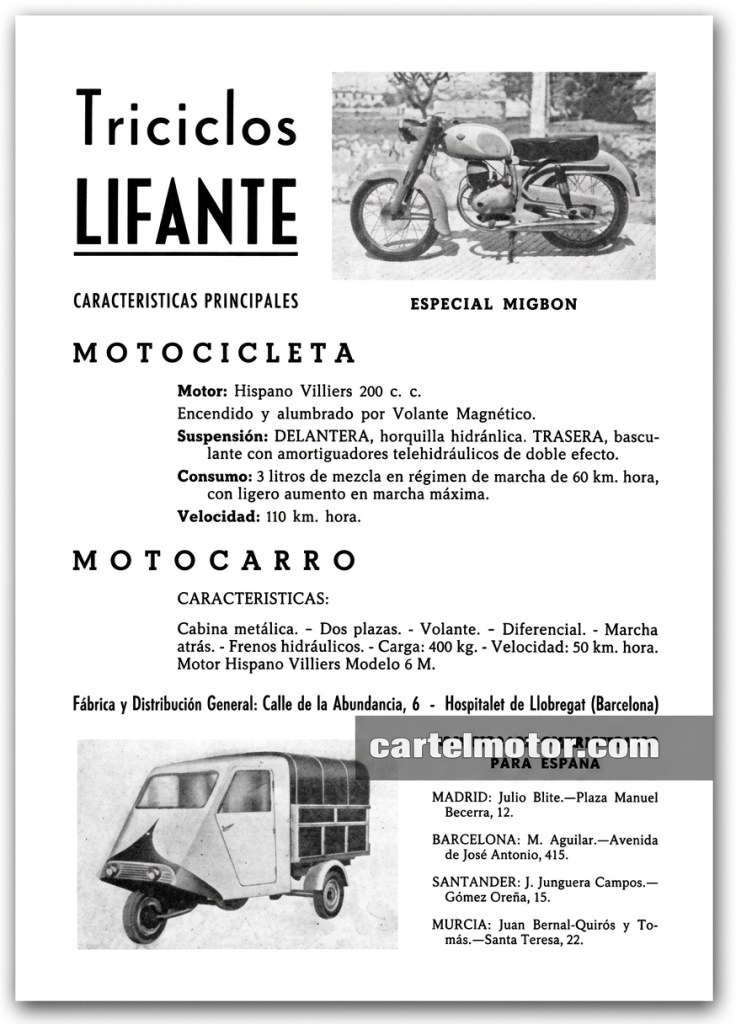
This publicity document was downloaded from http://www.cartelmotor.com
José Lifante originally founded the company Triciclos Lifante in Barcelona’s Raval neighbourhood in 1952/53. His experience had shown a lack of independent transport options for those individuals with physical disabilities in post-war Spain. He began designing and building specialized motorized tricycles for the disabled but eventually expanded into three-wheel delivery vehicles (motocarros), motorcycles and lightweight hand-powered cycles.
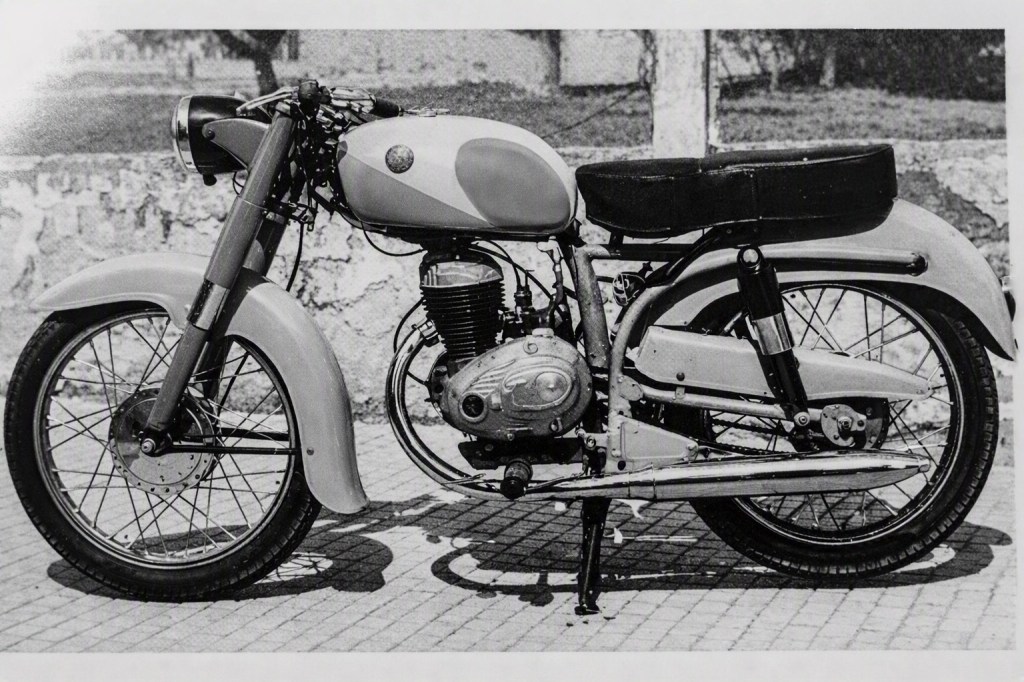
This image of a Lifante 200cc is taken from contemporary advertising material, with the contrast and graininess improved by MS Copilot.
Lifante built a number of motorcycles, although few examples survive. They were powered by Hispano Villiers 200cc (197cc), air cooled, 2 stroke engines and used a backbone type frame provided by Arcadio Dunjó, the prolific frame and sidecar manufacturer.
The Spanish motorcycle historian, Francisco Herreros, stated that production started in 1955 but was abandoned in 1960 after only circa 110 units had been built. Apparently Dunjó had designed a new, revised model for him but this was not taken up.
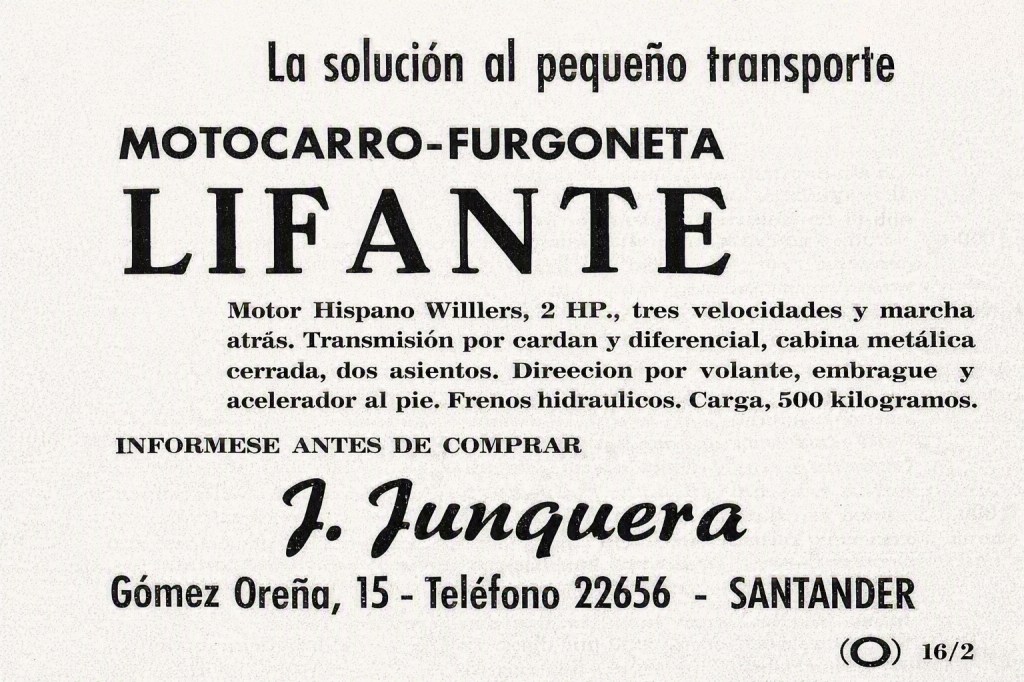
These 1950s adverts were downloaded from the Biblioteca Virtual de Prensa Histórica (BVPH). BVPH works are offered under CC-BY 4.0 license (Creative Commons Attribution 4.0 International – https://creativecommons.org/licenses/by/4.0/ )
In later years, the company would rebrand as Lifante Vehículos, S.A. and expand into electric wheelchairs, patent hoists for the disabled and vehicle modifications. As personal car ownership grew across Spain, Lifante transitioned from motorized tricycles into system design and the installation of modifications to road vehicles and other mobility aids.
Señor Lifante was a vocal and effective campaigner for the rights of the disabled with regard to mobility and improvements within the transport sector.
On the 4th May 1962, a major Spanish daily newspaper “Pueblo: Diario del Trabajo Nacional”, published a biography of José Lifante and his rise as a successful manufacturer of transport solutions. The article made the point that, within the 10 years since he entered the industry, his success had made him a millionaire.
In addition to manufacturing manual wheelchairs and other mobility products, the company continued to innovate. They developed vehicle modifications that included lowered floors and access ramps and señor Lifante himself drove a car modified by the company and fitted with hand controls.
As Lifante Vehículos, S.A. the company played a significant role in converting vans and passenger cars to comply with the emerging EU public accessible transport standards.
The management of the company passed to señor Lifante’s son but the ethos of development and innovation remained the same but by now, the company moved into more manufacturing of modern orthopaedic equipment. In 2005, the German mobility company – Meyra – acquired a 20% stake in Lifante and the company expanded beyond vehicle adaptations, into a full-scale medical equipment brand.
 Spanish Motorcycles