Ducson emerged as a distinguished Catalan marque, renowned for its compact motorcycles and mopeds, produced in Mollet del Vallès from 1954 until 1988. The enterprise behind these vehicles was Industrias Ciclistas V. Solá, SA, also known as IC Solá or ICSSA.
The narratives of Ducson and Derbi, another motorcycle manufacturer from Mollet, start at their joint inception. In 1925, Simeó Rabasa and his brother-in-law Vicenç Solá established the Rabasa-Solá bicycle workshop, near Can Solà in Mollet del Vallès. However, in 1929, the pair went their separate ways with Rabasa creating Bicicletas Rabasa (which would evolve into Derbi) in Martorelles, while Solá continued to operate from their old bicycle workshop.
Circa 1950, Solá initiated Industria Ciclista Vicente Solá, later renamed in 1957 to Industria Ciclista Solá, SA (ICSSA). Vicenç Solá’s retired in 1962 with the company passing into the hands of his sons, Andreu and Josep.
For years, the company built its reputation on building bicycles before expanding into the production of components for bicycles, mopeds, and the motorcycle auxiliary industry in the early 1950s. ICSSA specialized in manufacturing frames, fuel and oil tanks, and a range of other stamped steel components for two-wheeled vehicles. It became the leading provider of front forks that incorporated suspension for cycles that utilised auxiliary engines during the 1940s and 1950s.
Given its established infrastructure and its manufacturing experience in sheet metal components, the company decided to create the inaugural Ducson moped circa 1954. These first in-house mopeds were equipped with a 49cc Mosquito engine and featured a contact roller transmission system. The “Ducson” name selected by Solá was a marketing ploy and not an acronym – it was chosen for sounding English at a time when British motorcycles were world leaders.
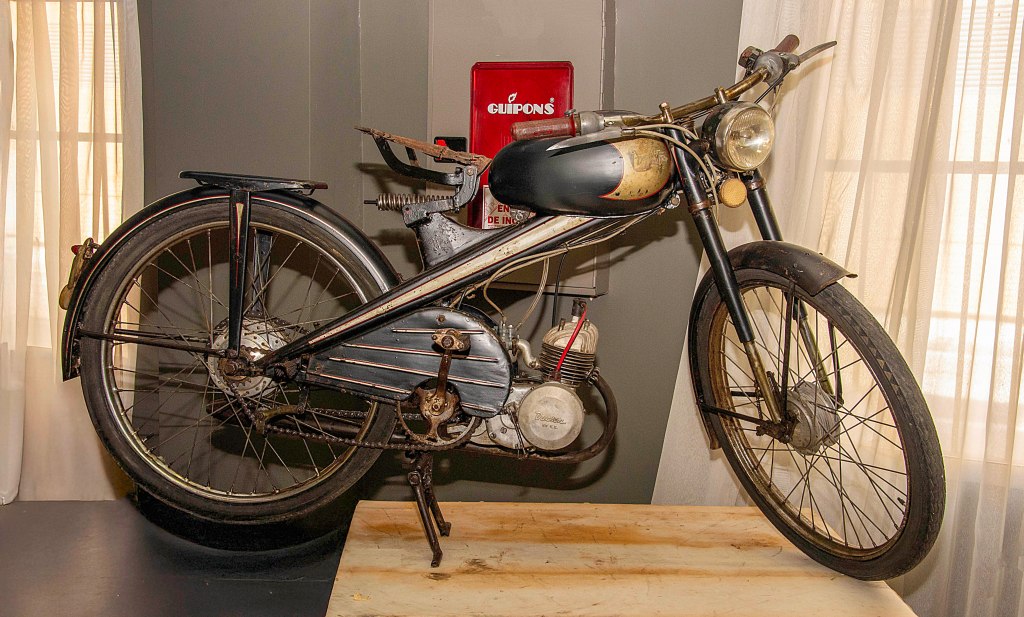
1955 Ducson moped with 50cc Setter engine on display with the Sala Santy Collection
In 1955, this first model was replaced by a moped from Setter from Elche, also of 49cc and Setter continued to produce engines for use by Ducson.
In 1958 a new moped model appeared and then, by 1960, Ducson was experienced in competition, which allowed it to create a new model, the Ducson Repris.
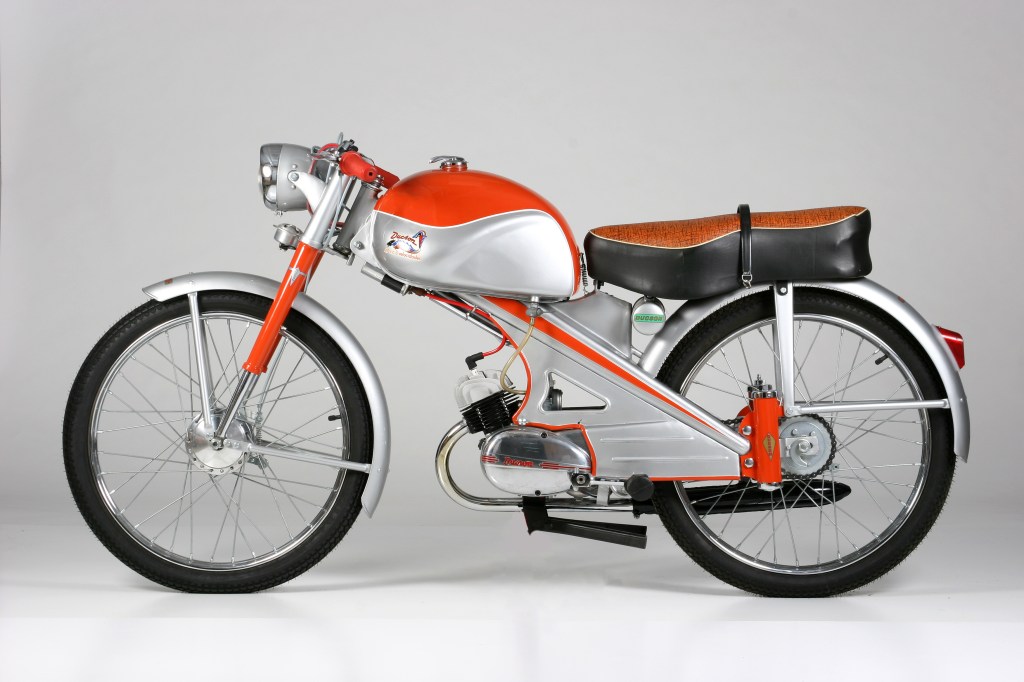
This Ducson Reprise was loaned by Antonio Flores and was photographed at the Museu de la Moto de Bassella (Catalonia) by Joan Carles Orengo and reproduced here, with the logo, with his permission. ©JoanCarlesOrengo
In 1962, two new models appeared, the 49 and the 49 Sport. The chassis in the new models was a cradle type and, whilst the 49-model continued with the old Repris engine, the 49 Sport came with an uprated engine of 4.5 HP output and an increased 90 km/h maximum speed.
After this, new models appeared that incorporated some styling variations, known by designations: S8, S9, S10, S12, S15 and S16 for the road going models (and S20, S21 and S30 for the off-road models).
The demand for mopeds decreased and the company started diverting resources into the stamping of parts for the automotive sector. An attempt to generate new interest (and sales) came in 1981 with the launching of new models, both of which incorporated Italian Franco Morini engines . These models were the last mopeds produced by Ducson and in 1988 moped production halted. In an effort to turn back the clock, Ducson manufactured parts and components for the motorcycle sector as it had at the outset, until it eventually closed its doors a few years later.
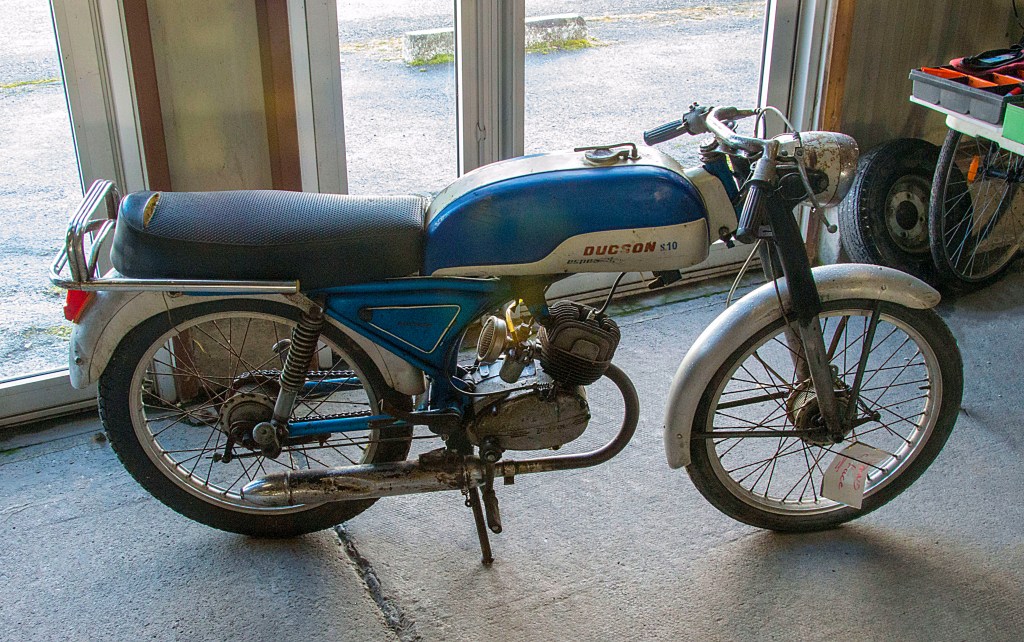
The Ducson S10 above was photographed at a Bourse in Marmande (47, Lot et Garonne) in 2018.
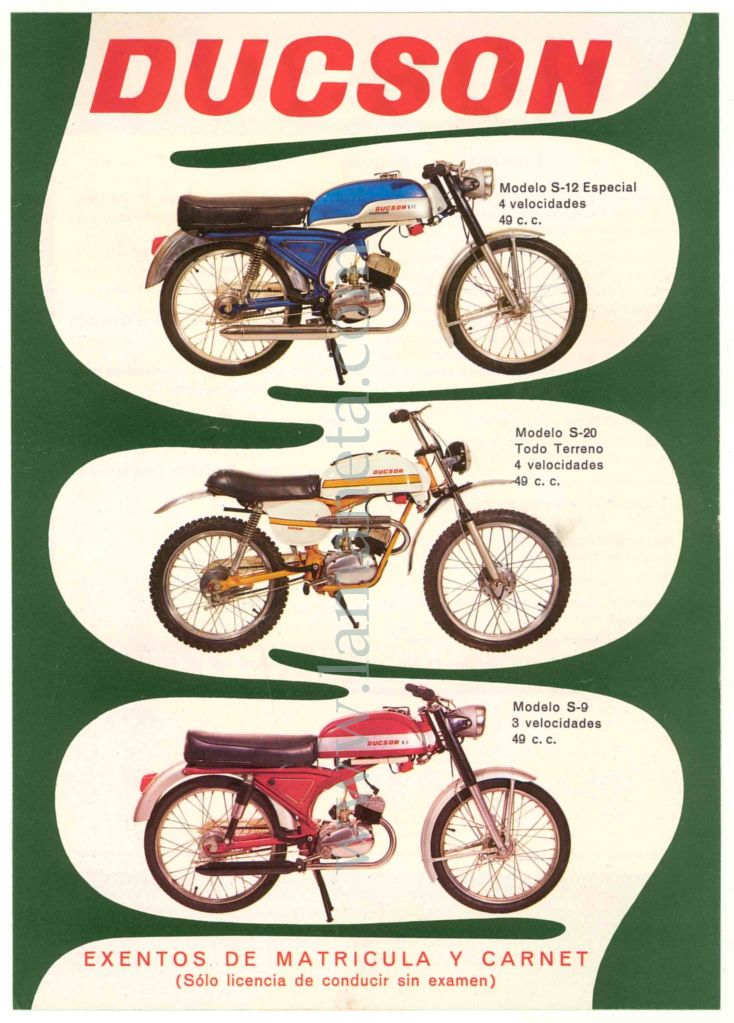
This advertisement is reproduced with the kind permission of the Lamaneta website http://www.lamaneta.com
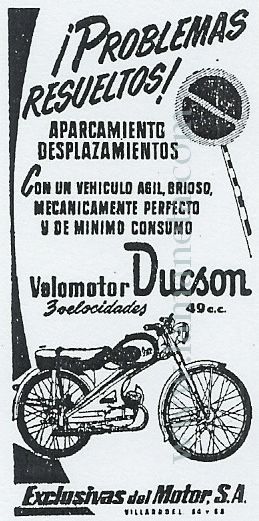
This advertisement is reproduced with the kind permission of the Lamaneta website http://www.lamaneta.com

