
I have no image of a Colibri logo, so I have used a Basque Flag – the Ikurrina – via Wikimedia Commons.
Daniele Schirmo aka Frankie688, CC BY-SA 2.5 https://creativecommons.org/licenses/by-sa/2.5
Initialy, I need to dispel the common misconception, Colibrí is not an actual bicycle brand but was an auxiliary engine for fitting to bicycles. The engines were produced in the precision engineering workshops of Alberto Bonelli in Durango (Vizcaya) between 1948 and 1952. This was the post-war boom period of demand for worker mobility.
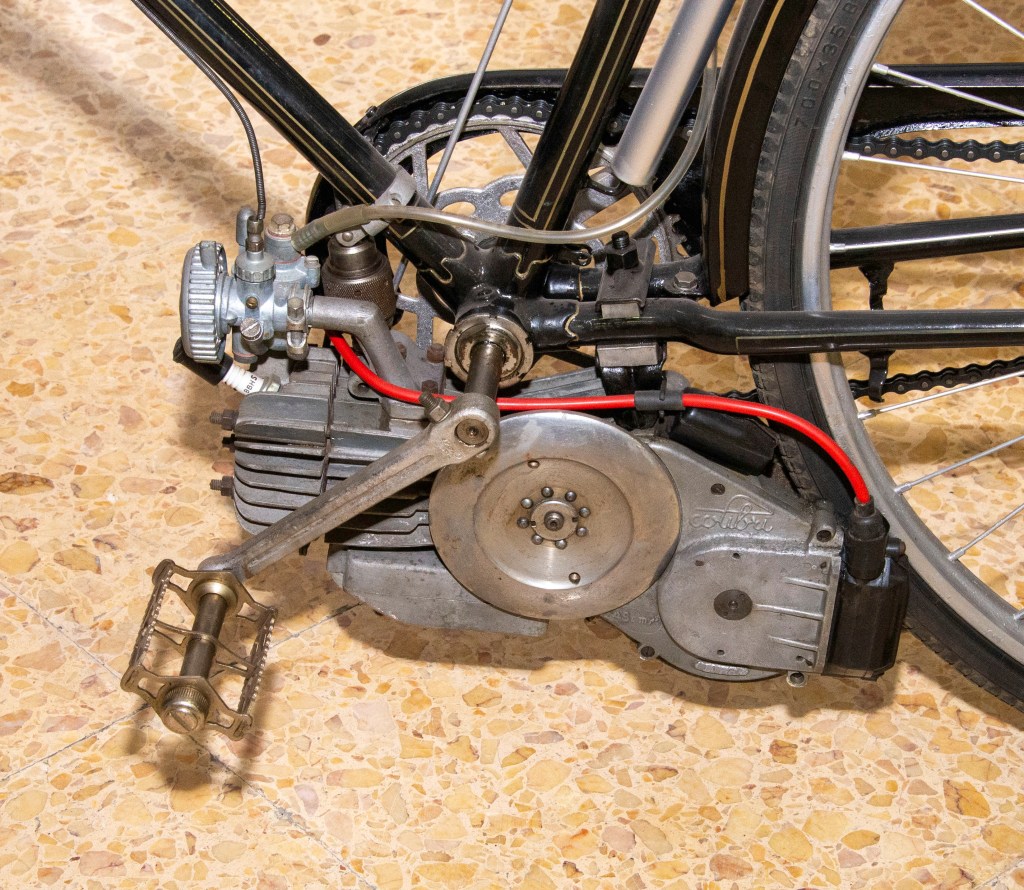
This is a Colibri 48cc auxiliary engine, mounted on a BH brand bicycle that was on display as part of the Sala Santy Collection.
The initial engines were 48cc, two‑stroke, clip‑on style engines that mounted under the bicycle bottom bracket and used a knurled, contact roller transmission system. In 1950 the engines were modified as the Colibri 45, which incorporated a clutchless 2 speed system that allowed steeper gradients to be climbed (14%) without resorting to pedal assistance.
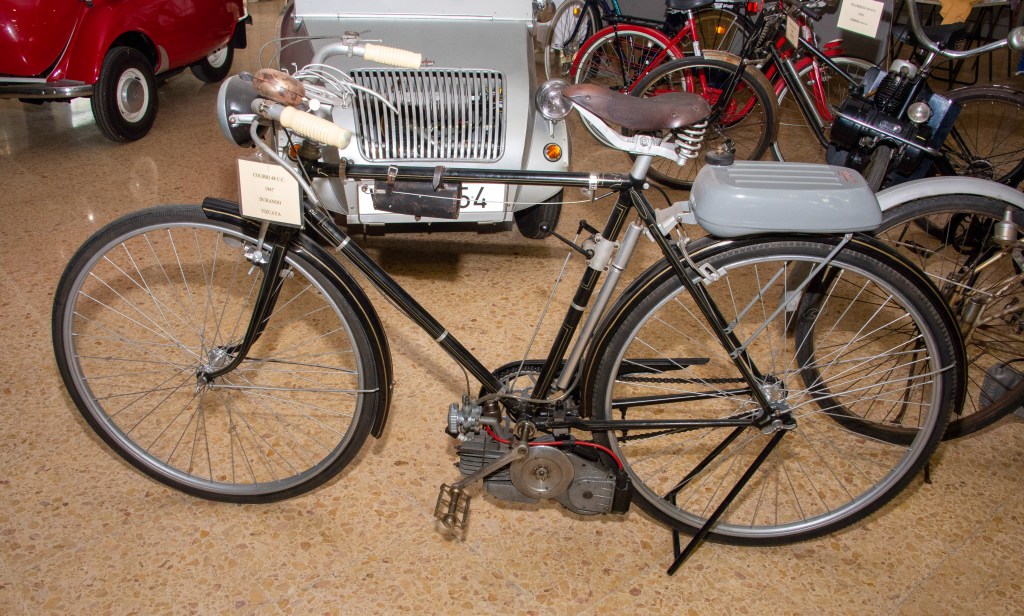
On this photo of the BH bicycle, you can see the flat fuel tank mounted above the rear wheel.
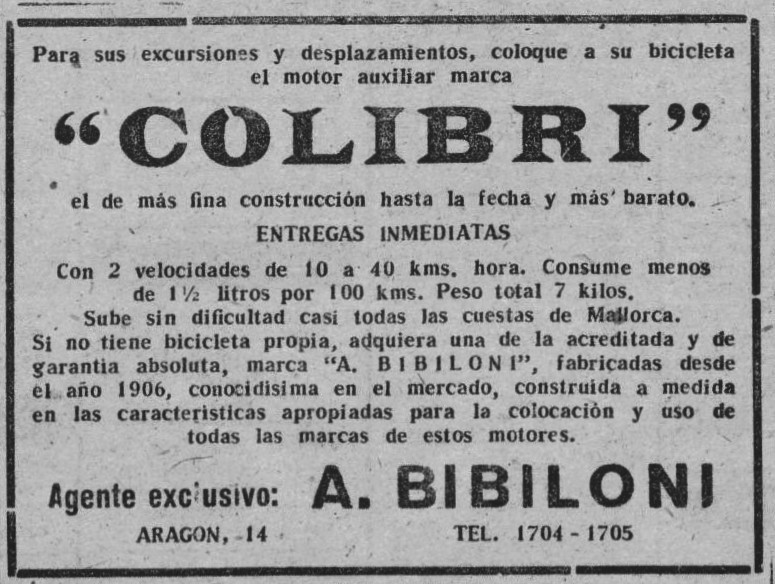
Advert is from the Zaragoza Municipal Newspaper Archive
In 1951, Alberto Bonelli made the fateful decision to design and build a Scooter – the Febo. It was very futuristic with a steel monocoque type chassis with an air cooled, two stroke, 125cc horizontal engine. The passenger seat was retractable and the spare wheel was carried under a front hood. The project drained Bonelli of both resources and working capital and, in 1952, he had no alternative but to sell the design for the Colibri auxiliary engines. These were bought by Zugaza – another local firm.
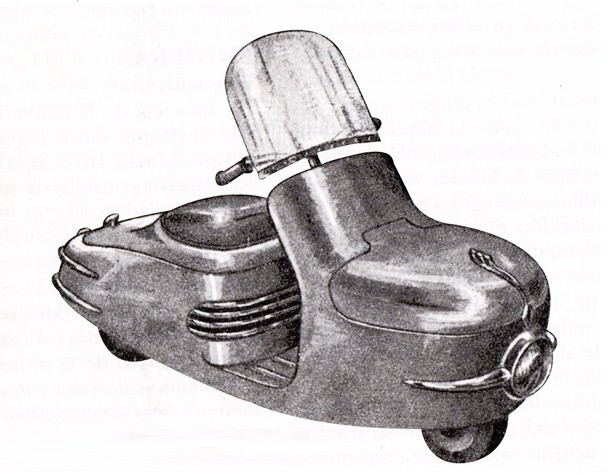
I have been unable to find any photos of the Febo and this line drawing is reproduced with the permission of OTTW – One Two Three Wheels.
To my knowledge only a maximum of 6 prototypes were build and the Febo never entered production. After selling the rights and design of his auxiliary engine, Alberto Bonelli ceased production in late 1952. The Febo was entering the market at the same time as Vespa and Lambretta and just could not compete on costs.
 Spanish Motorcycles