My initial interest in the Arisco goes back to a visit in 2016 to the motorcycle museum in Barcelona (now closed) and the Museu de la Moto at Bassella. On display were examples of the Arisco – the air-cooled version was at Barcelona and the water-cooled version at Bassella.
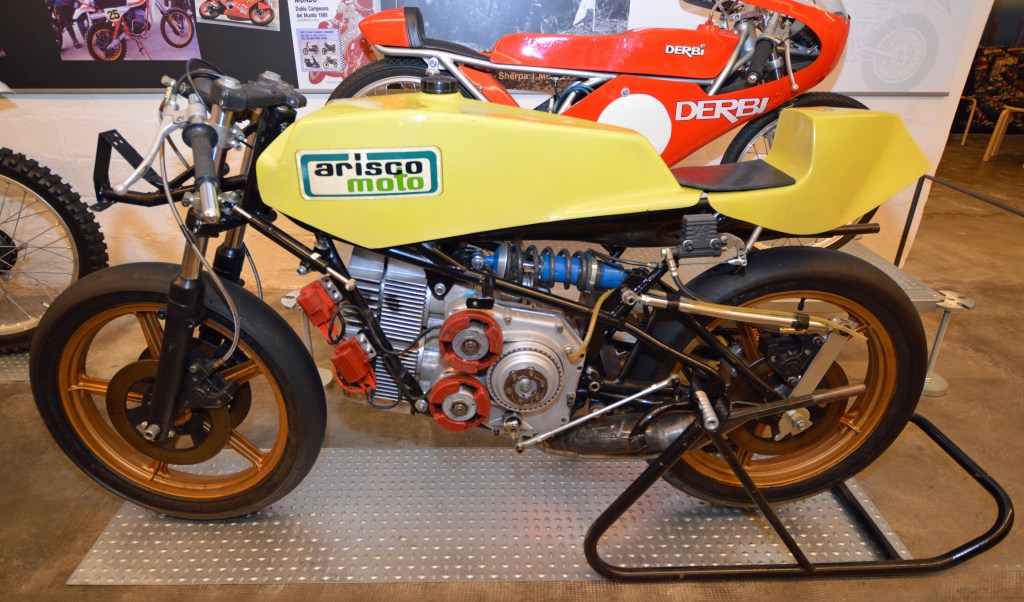
The air cooled Arisco in the above photograph was in the Museo de la Moto de Barcelona in 2016
I attempted to research the Arisco in more detail to update my photo captions but there was relatively little data in the public domain. With what I could find, I became more and more intrigued by the exploits of Senor Miguel Tapias Tudó, the Arisco moto creator. I have written a more detailed history of Senor Tapias and his exploits that was published in Motor Classico in Spain. I am concentrating on the Arisco bike here but will add the fuller story as a “blog post”.
Miguel Tapias Tudó was born in Terrassa on 07 August 1933. Terrassa is the third largest city in the province of Barcelona, situated in the east central region of Catalonia, Spain and 20 kilometres from Barcelona.
Miguel Tapias trained as a draughtsman and he went on to create the company – Miguel Tapias Construcciones Mecánicas – in Calle de la Riba, Terrassa. Here he manufactured and marketed trailers for motorbikes and industrial tools. There is anecdotal evidence that he had grown frustrated with the poor quality of industrial tools then on the market and he believed, correctly, that he could produce a better-quality product.
In 1968, he started to manufacture kart chassis from his premises in Calle de la Riba, Terrassa and he created the company MTK (Miguel Tapias Kart). He continued the Kart production and expanded in to new premises at in Calle Vallparadís 63, also in Terrassa. His initial Karts were powered by Montesa 100cc engines before, in 1969, he started to produce his own Arisco engines.
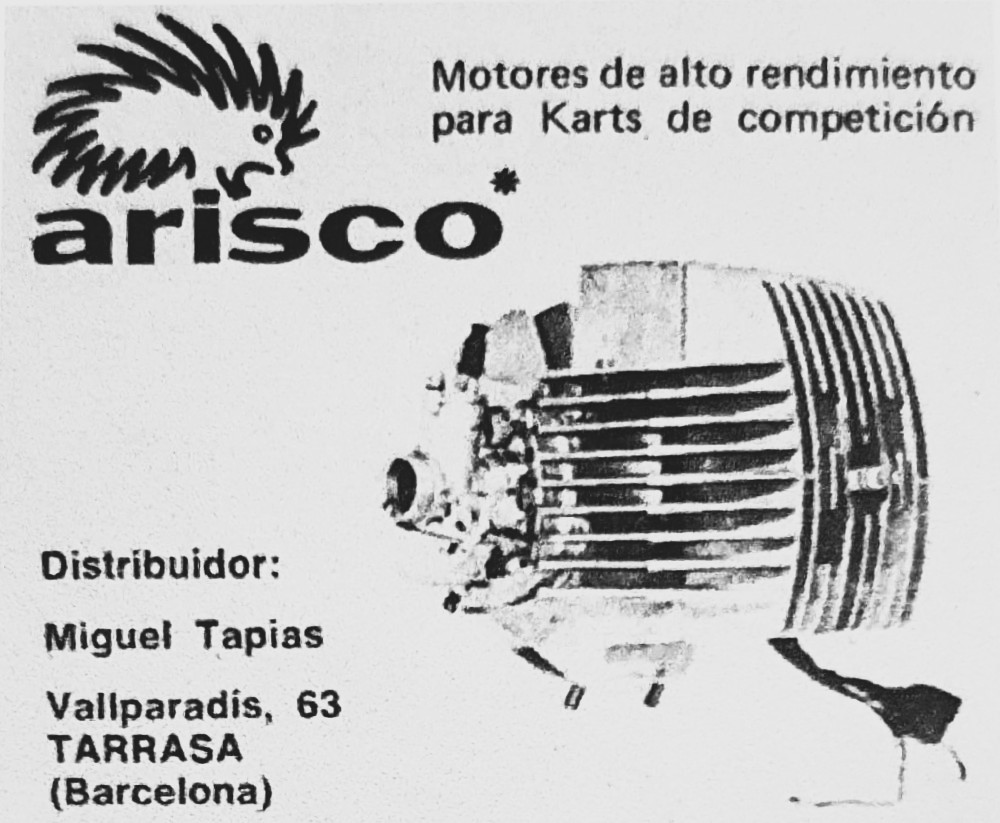
After his experience with the Montesa engines, he came to appreciate the advantages of the rotary valve Italian engines and decided to take that route, when designing his own engine. The MTK Karts were successful in competition, winning both Spanish and Catalan Championships in their time.
Miguel Tapias was a visionary and he saw a possibility to develop his Kart engine and create a 250cc motorcycle. Initially, he had hoped to put the bike into production, but financial constraints and administrative hurdles proved to be too costly. Instead, he developed the bike to be a home grown 250cc road race machine.
He had a design in mind for his 250cc twin cylinder engine and his solution was to superimpose two of his Arisco Kart engines on themselves. He began work on this in early 1976 and the initial prototype engine was mounted in a Kart for testing.
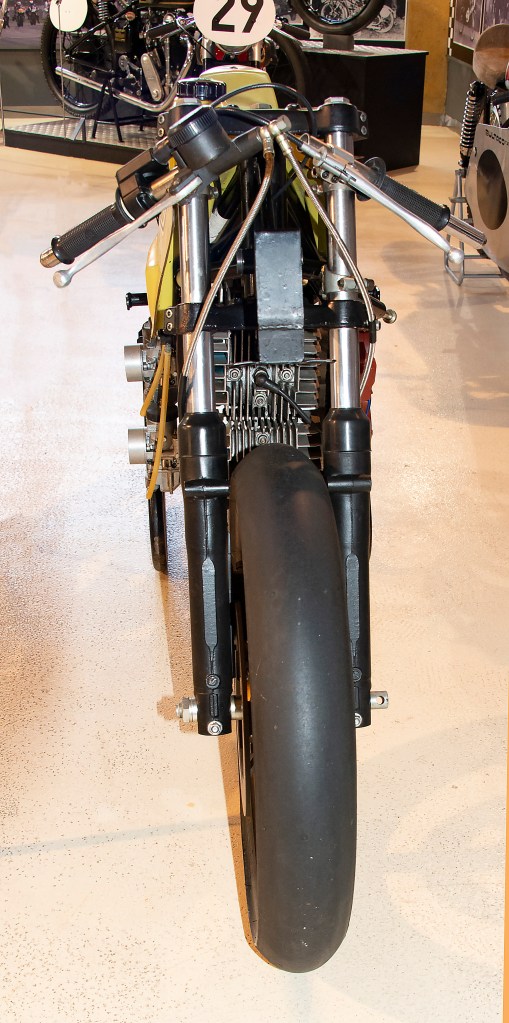
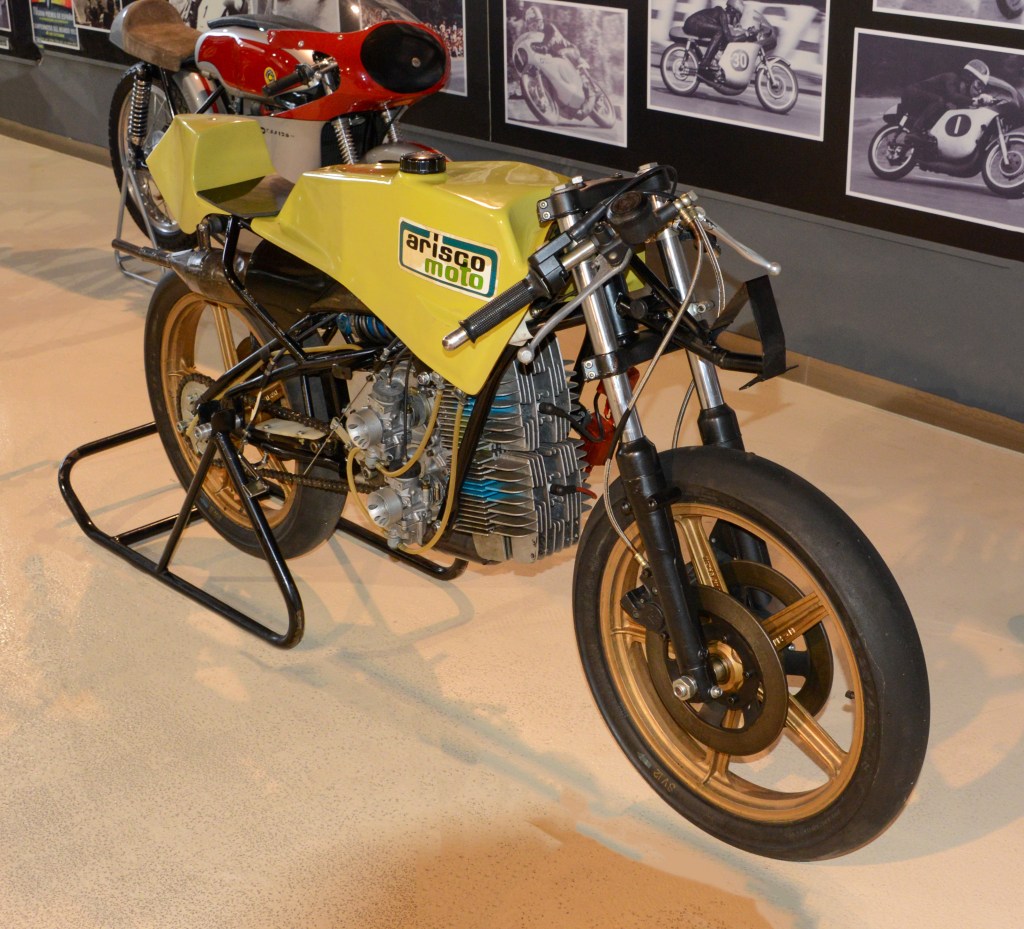
The photo above shows the narrow profile of the Arisco with the over/under cylinder layout and exhaust outlets at the top and the bottom.
After testing in the Kart had proved the feasibility of the design, he built a tubular frame to house the engine, with the rear swingarm incorporating a Selex shock absorber. The engine(s) ran with separate carburation, separate Motobloc ignition systems, separate crankshafts etc. The cylinders had a 56mm x 50.6mm bore and stroke giving a total displacement of just over 249cc. His design of superimposing the two engines in the build, whilst positioning the exhaust ports at the top and bottom, meant that he gained a very narrow profile with the exhausts mounted above and below the engine.
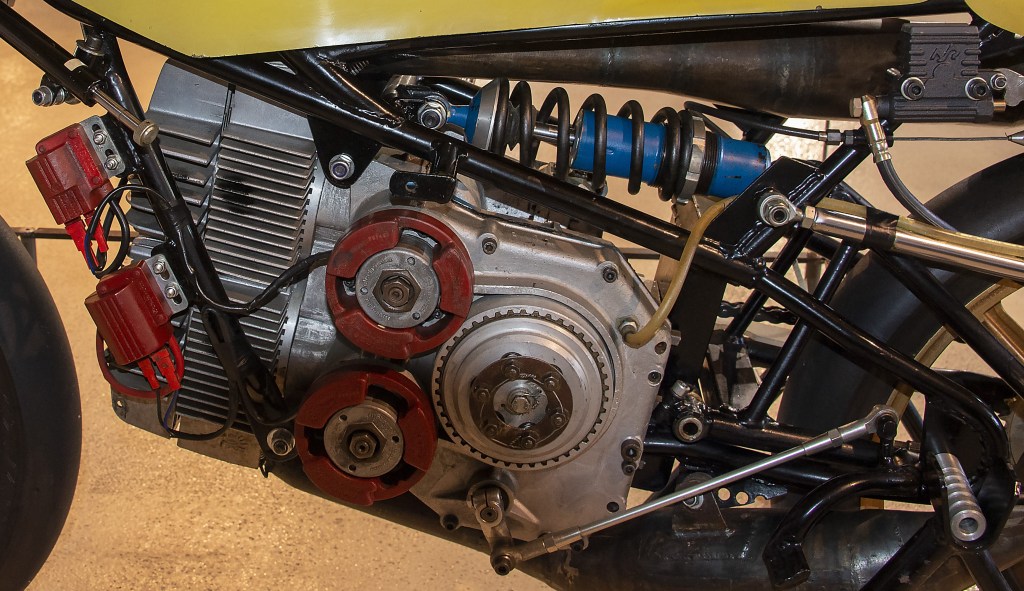
The engine, in 1978, was mounted in a multi-tubular chassis and the ancillaries are easily seen here. The separate orange Motobloc ignition systems, the dry clutch and the large, central, Selex shock absorber.
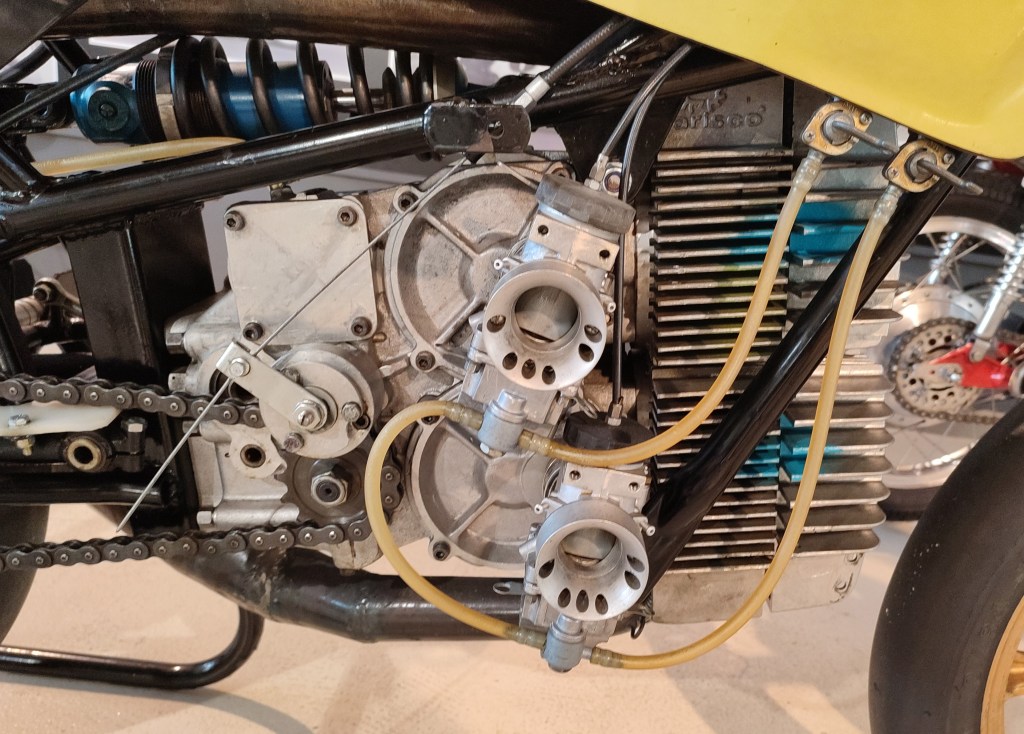
In its earliest form, the engine had Bing 28 mm carburettors (but later plans were to use laterally mounted Amal carburettors), rotary valves and a six-speed gearbox and was estimated to provide 45 CV. The engine could reach 11,000 RPM but the usable power spread was assessed at between 8,800 and 9,500 RPM. Stopping power was supplied by RECMO discs, front and rear. The bike underwent testing at the Calafat circuit, with Salvador Cañellas the Test Rider. In 1977, the first Arisco motorcycle – although still incomplete – was presented at the Barcelona Motor Show.
In 1977, the magazine Solo Moto were invited to test the first Arisco moto at the Calafat circuit and they published a detailed appraisal of the potential of the bike and of those areas that would need to be addressed. Then, in 1978, they offered an Arisco 250cc as the prize in the Solo Moto Criterium series, sponsored by AGV.
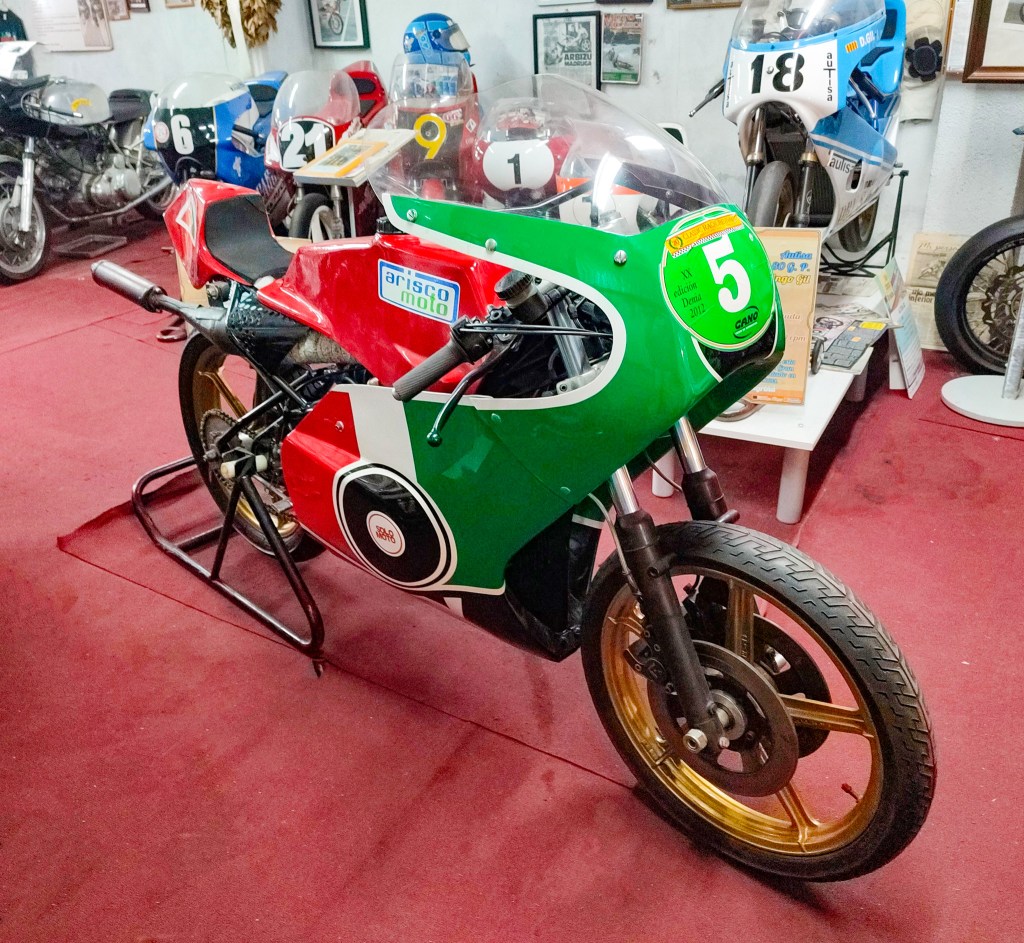
In 1978 that series was won by the famous Spanish racer, Domingo “Mingo” Gil and “his” Arisco was subsequently sold on and is now displayed at the Ramon MAGRIÑA Collection at Masllorenc (Catalonia), where I photographed it in 2023.
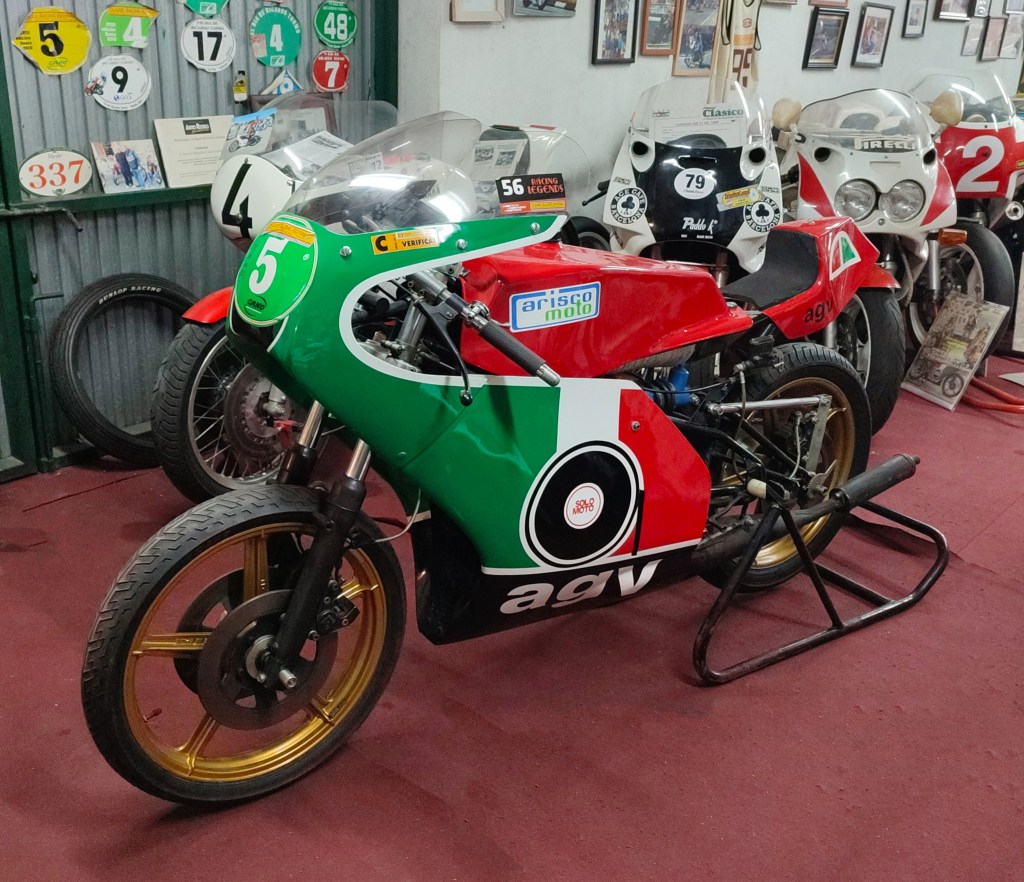
The Arisco won by Domingo “Mingo” Gil in the 1978 Solo Moto Criterium series is now displayed at the Ramon MAGRIÑA Collection at Masllorenc (Catalonia)
Senor Tapias had already developed liquid cooled variants of the Arisco engines, and they were being used in the MTK Karts. The conversion of the Arisco moto engine to liquid cooling was the next logical step.
What was to be the final embodiment of the Arisco moto project also included a radical new monocoque frame, as seen in the following photograph.
I was fortunate enough to see the bike when it was on public display at the Bassella Museum. To my knowledge, this is the only liquid cooled version that Senor Tapias built and the only version of this frame. This unique motorcycle remains in the possession of the Tapias family.
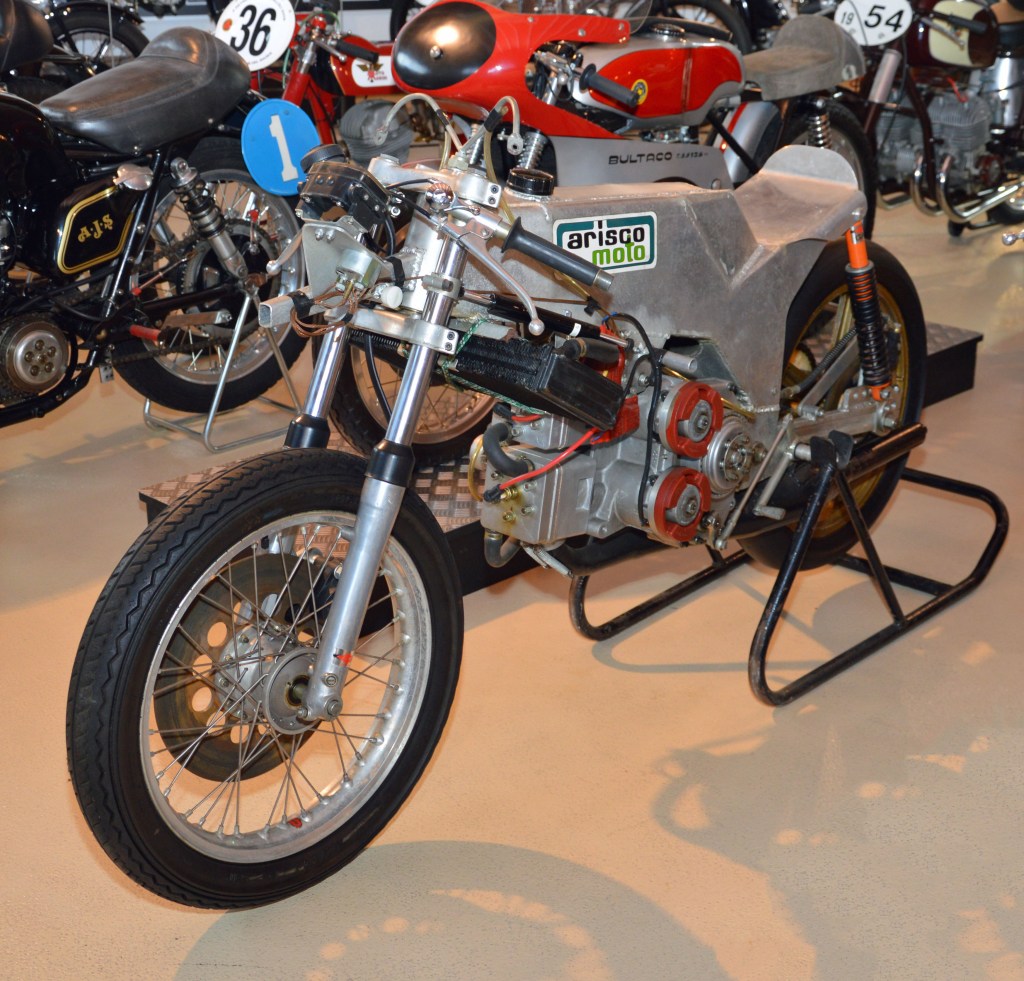
The “final” version of the Arisco, liquid cooled and mounted in a monocoque chassis and photographed at the Museu de la Moto – Bassella .
The angled radiator can be seen mounted under the front of the fuel tank and there is now a more conventional rear suspension set-up. The more distinctive separation between the two cylinders is more obvious on this liquid cooled variant and is clearer in the next photo. It is believed that by this version, the engine was producing approximately 50 CV.
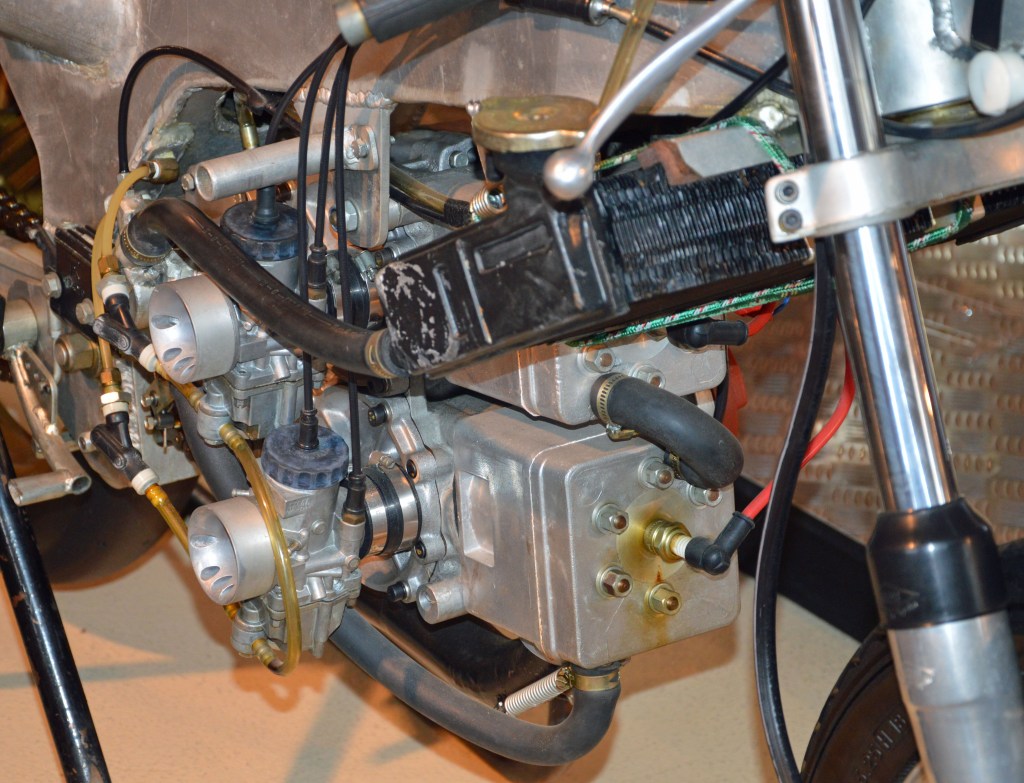
Tragically, Miguel Tapias became ill with Parkinson’s Disease in the early 1980s and died on the 24 May 1995 at his home in Terrassa. He was survived by his wife, a son and a daughter.
Footnote: Since I first started to research the history of the Arisco and the exploits of Miquel Tapias, I have been in contact with his son, Quicu Tapias. I am delighted to learn that the Municipality of Terrassa is to mark and honour the life and work of Miquel Tapias with a ceremony, a plaque and a webpage inclusion on the Terrassa Website. As Senor Tapias started me on this journey, I look forward to seeing the plaque and adding a photo of it to this site.
 Spanish Motorcycles